How HeelNext works
Four steps, all free. Most people get through the first two in under five minutes.
Two ways to use HeelNext
The free tools are enough to start properly. The toolkit is for when you want the whole method in one place: what comes after the starter plan, how to progress, and how to get back to the things you’ve stopped doing.
| Free | Toolkit | |
|---|---|---|
| Safety screen and red-flag guidance | ✓ | ✓ |
| Self-check to choose a starting section | ✓ | ✓ |
| What each treatment is actually for | ✓ | ✓ |
| Starter plan and daily tracker | ✓ | ✓ |
| Full Rebuild Ladder and the eight progression dials | — | ✓ |
| Exercise video and illustration library | — | ✓ |
| Return pathways: walking, work shifts, gym, running, sport, travel | — | ✓ |
| Appointment Summary built from your tracker | — | ✓ |
| 76-page visual guide with 12-week tracker and worksheets | — | ✓ |
| Safety information stays free, always. If the safety screen sends you to a clinician, the Appointment Summary unlocks for free too. | ||
Before you buy: straight answers
Do I need the book as well?
No. The toolkit is self-contained. The book, Plantar Fasciitis (Plantar Fasciopathy), is the longer story of why heel pain behaves the way it does. The toolkit is what to do this week.
Is this physiotherapy or personal medical advice?
No. It’s educational material for adults whose heel pain has already been assessed as plantar heel pain. It can’t examine your foot and it doesn’t replace your physiotherapist, podiatrist or doctor. It helps you organise what you do between appointments and keep a clear record of how you respond.
Who shouldn’t buy it?
Anyone whose pain hasn’t been assessed, or whose safety screen flags something: start with an assessment instead. If you have diabetes, neuropathy, reduced feeling in your feet or a circulatory condition, or you’re pregnant, only use it with a clinician’s guidance.
Can I use it on my phone?
Yes. The guide is a PDF that opens on a phone, tablet or computer. The video library and members’ sections are on heelnext.com, reachable by link or QR code. The daily tracker on this site works in your phone’s browser.
Do I have to print anything?
No. The 12-week tracker and worksheets are printable if you like paper. The online tracker works without printing.
What happens if I change phone or browser?
Enter your licence key again on the new device. Your download also stays in your Gumroad library. Tracker entries are stored only in the browser you used, so use “Export CSV” on the Tracker tab before switching.
Is it a subscription? Are updates included?
One payment, no subscription. Updates to the guide are free.
What currency will I pay in?
The price is $47 USD. Gumroad shows the equivalent in your local currency, plus any applicable tax, before you pay.
Questions about your purchase, or a refund?
Email info@serenesprints.com. A real person answers.
Why this exists
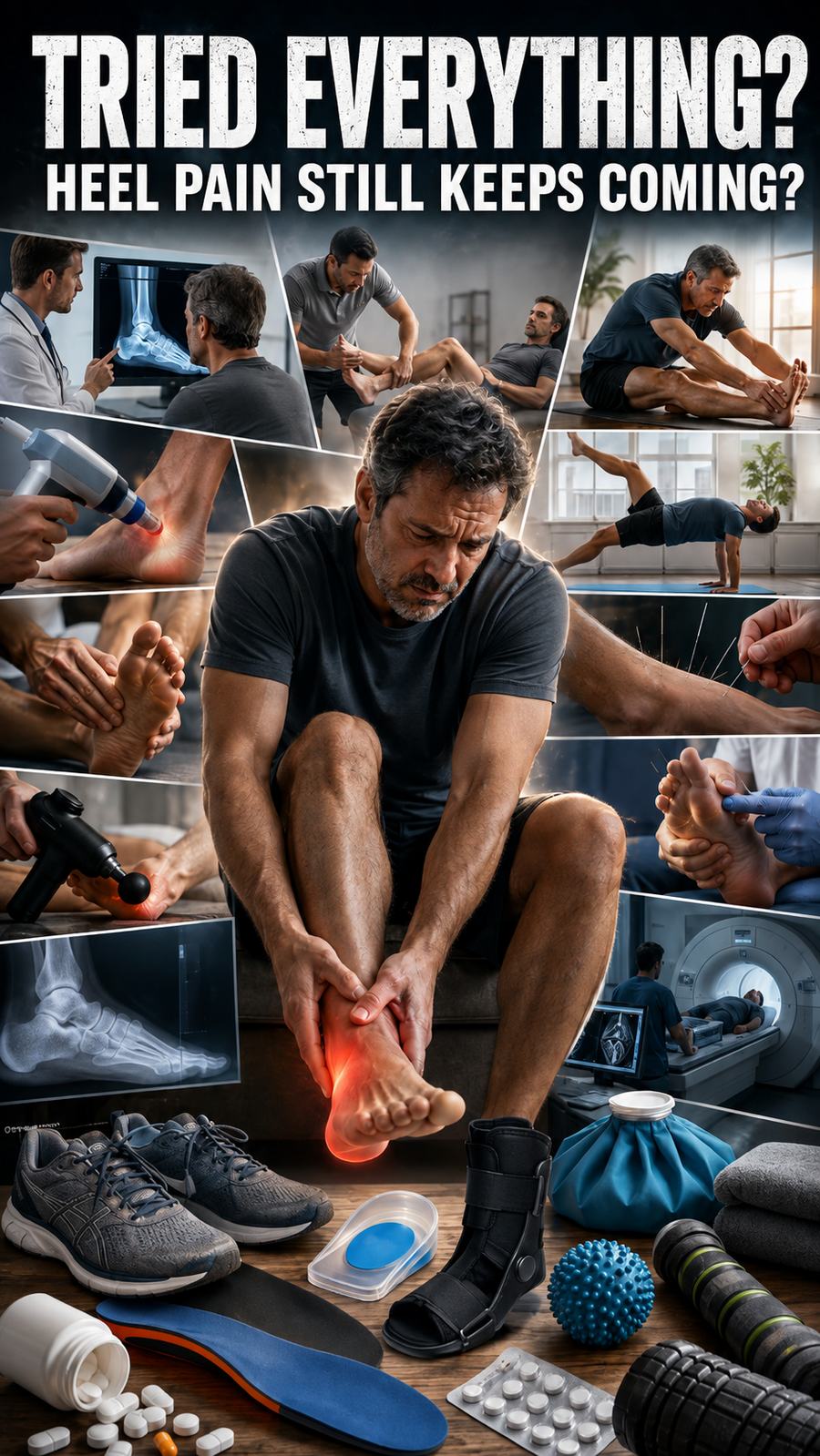
I had plantar heel pain for four years. Cortisone injections in two countries. Shockwave. Acupuncture. Insoles, night splints, heel cups, foam rollers, massage balls. Fifteen days of a man striking my heel with an iron hammer.
Almost every one of those things had a defensible reason behind it. What nobody ever did was tell me which job each one was doing. So I judged all of them by whether they cured me, concluded everything had failed, and kept buying the next thing.
HeelNext is what I wish I’d had: fewer wrong purchases, one clear next step, and a way to tell whether it’s working.
The mistake that cost me four years
I judged every single treatment by whether it cured me. Ice — no. Insoles — no. Cortisone, shockwave, stretches, physio — no. So I concluded that everything had failed, and kept buying the next thing.
Asking whether an ice pack cured my plantar fasciitis is like asking whether a seatbelt got you to Manchester.
It isn’t a criticism of the seatbelt. It was never doing that job.
Know what job you’re paying for
Insoles, night splints, massage guns, new shoes: most have a sensible reason behind them, but each one does a single job. The What to buy tab sorts them into “worth having” and “save your money”, so you know what you’re buying before you buy it.
Always worth the money: a proper assessment. If the safety screen flags anything, please go.
Is this something you should be self-managing at all?
The hidden first question, and almost nothing on the internet asks it. Tick anything that is true for you.
Does your pattern fit?
Plantar heel pain is not the only cause of pain under the heel. Fat pad problems, bone stress injury, nerve entrapment, a fascia tear, Achilles problems and inflammatory conditions can all turn up in the same neighbourhood. This can't tell them apart. It can only ask whether your pattern looks unusual.
Choose a starting section
Seven questions, about two minutes. Most heel-pain advice is written for someone at a different point than you — which is a large part of why it doesn't work.
What this does: points you to one of three starting sections, so you have somewhere to start instead of trying everything at once.
What it doesn't do: diagnose anything, identify a stage of your fascia, or tell you how much walking is safe for you specifically.
What each thing actually does
This is the single most useful idea on this page, and it's why so many people conclude that "everything failed."
Most people judge every treatment by whether it cured them. That's a category error. Different tools do different jobs, and a tool that did its job perfectly still looks like a failure if you measured it against the wrong one.
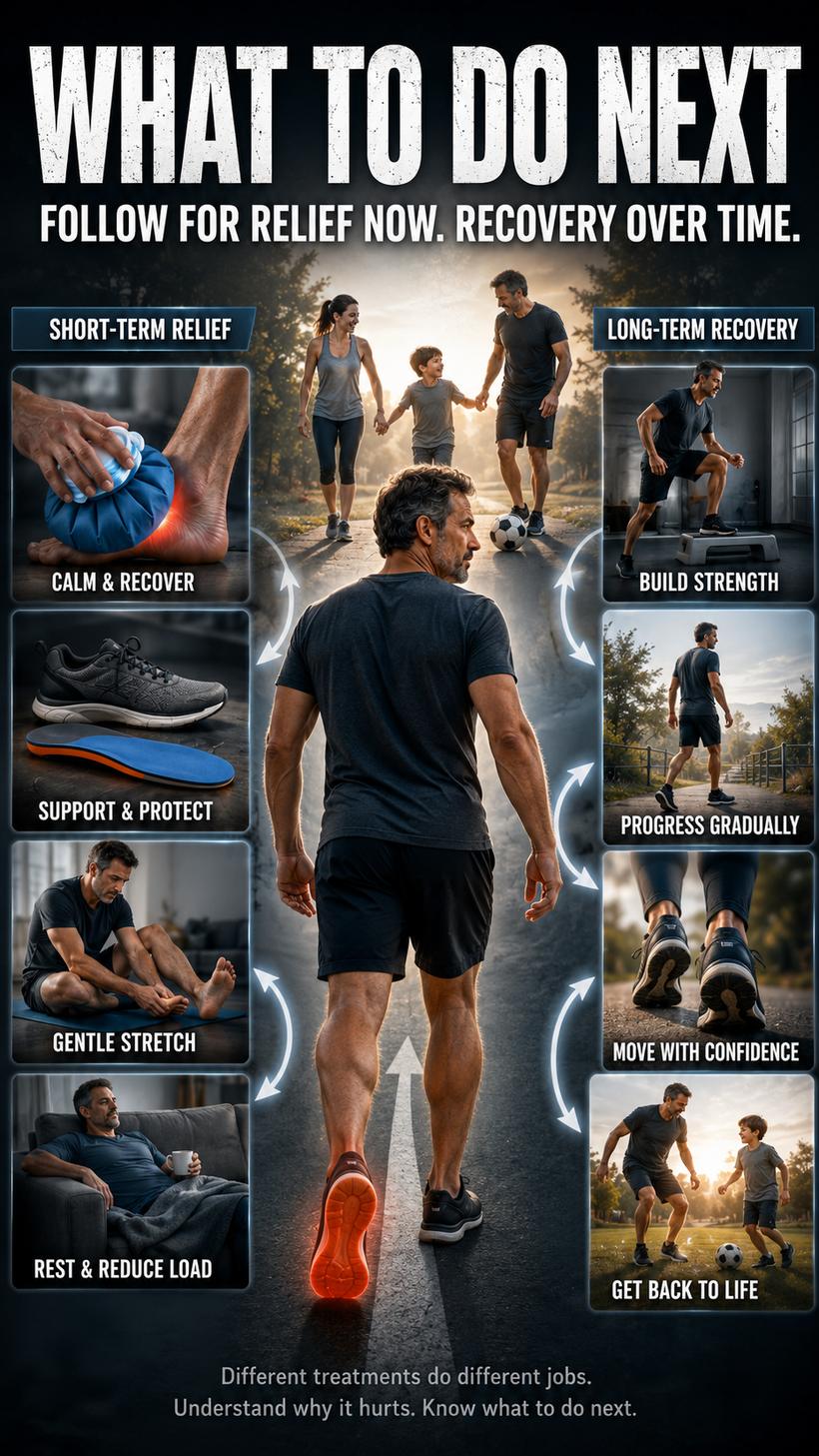
Ice never failed to cure your heel pain. Ice was never a job-four tool. Nor were your insoles, nor your taping. They're job two and job three, and judged on those jobs several of them probably worked.
What's almost always missing is job four and job five — capacity and return. That's where the years go. And they're the cheapest two on the list.
What the medical options can and can't do
None of this is a reason to avoid them. It's so you know what you're buying.
The plan that costs nothing
A wall, a step, and a rolled-up towel. That's the whole equipment list.
Looking for quick relief rather than a plan? Morning routine and relief tools →
Two rules that matter more than the exercises
Start below what you think you can do. Not at it. Below it. Starting where you think you should be is the most reliable way to have a bad week.
Change one thing at a time, then watch for about a week. One. Not two because they're both small.
Today
Two weeks of honest notes beats two weeks of enthusiastic guessing. Function gets equal billing with pain on purpose — a tracker that graphs only pain teaches pain-watching.
Where you are
Reading the response
Read symptoms + function + trend together. Never pain alone.
Amber is the light everyone ignores. Green feels like permission and Red feels like a wall; Amber feels like nothing much, so people treat it as Green and progress anyway. One bad morning is noise. Three in a row is a trend.
Appointment Summary
Ten minutes with a clinician is worth far more when you arrive with data instead of a narrative. This reads your tracker and fills in what it can.
Appointment Summary
Self-reported data from a personal tracking log. Not a clinical assessment.
| What | How long | Effect |
|---|
Produced from a self-management tracking log. It records what I have observed; it is not a diagnosis and does not replace clinical assessment.
Before you buy another heel-pain product
Know what job you're paying it to do.
Worth having, if it helps you
Save your money
Things that are unnecessary, weakly supported, duplicative, or replaceable with something you already own.
Want the whole method in one place?
The free tools stay free. The toolkit adds the full progression ladder, video demonstrations, return pathways and worksheets, organised for use again and again.
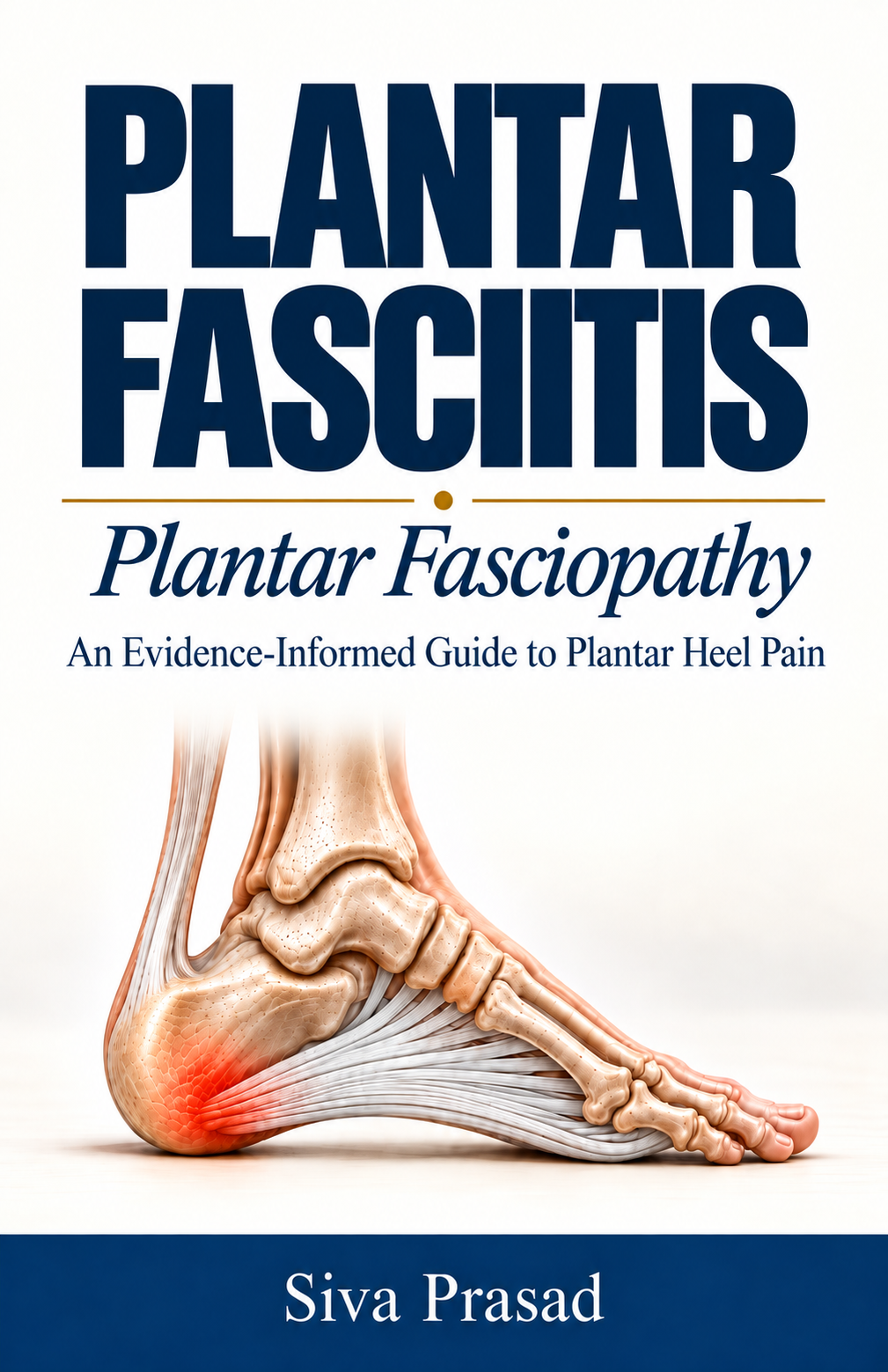
Prefer to read first? Plantar Fasciitis (Plantar Fasciopathy) is the book: the longer story of why heel pain behaves the way it does ($9.99 ebook). You don’t need it to use the toolkit. The book explains why; the toolkit is what to do this week.